

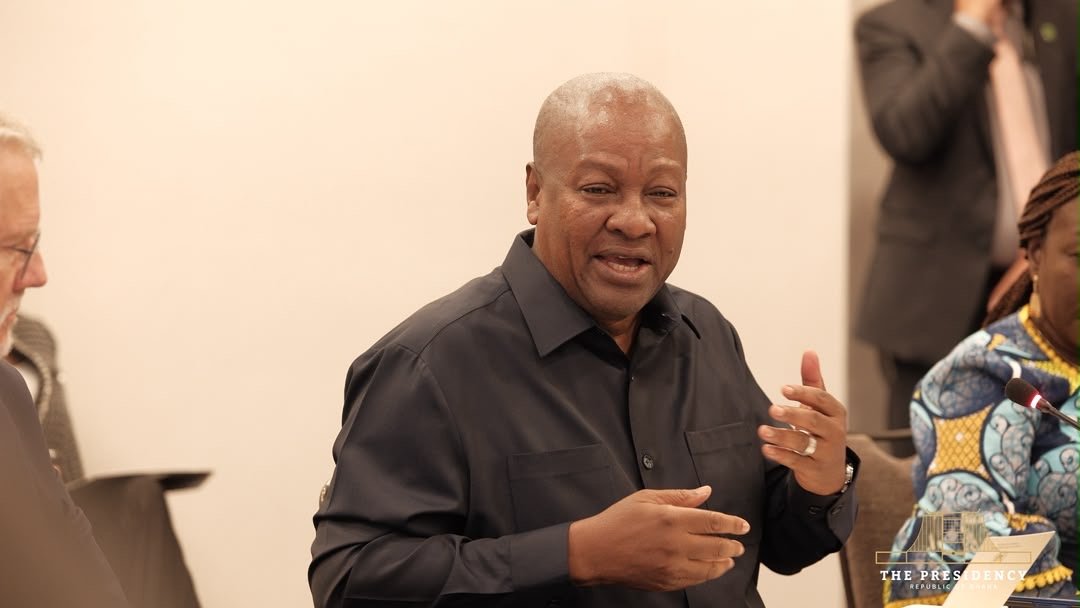
President John Dramani Mahama has called for the unconditional return of African human remains held outside the continent, while urging the United Nations and countries holding African cultural property to establish standardised mechanisms to facilitate restitution.
Speaking at a high-level side event on the return and restitution of cultural properties and heritage on the sidelines of the 81st United Nations General Assembly in New York on Wednesday, September 23, 2026, President Mahama said restitution must move beyond isolated acts of goodwill to a permanent and institutionalised global system.
He called on the United Nations and holding nations to establish clear legal and diplomatic mechanisms to streamline provenance research, improve access to archives and lower legal barriers to restitution, beginning with the “unconditional return of all human remains.”
“Human remains are not collectibles. They are not specimens. They are our ancestors,” President Mahama said, stressing that restoring them was not merely a question of legal ownership but a test of shared human dignity.
He cited the case of King Badu Bonsu II of Ahanta, whose head was taken to the Netherlands after his execution by Dutch authorities in 1838 and preserved there for about 170 years before being returned to Ghana in 2009.
President Mahama also referenced the return of the sacred Mpomponsuo sword to Ghana in 2024, following the looting of the Asantehene’s palace during the British destruction of Kumasi in 1874, as evidence that returned artefacts remain connected to living traditions and communities.
President Mahama outlined three pillars underpinning Ghana’s proposed “Next Steps” on cultural restitution.
The first is the establishment of a permanent global system for restitution. He acknowledged progress by countries including the Netherlands, Germany and France, as well as the return of the Djidji Ayokwe talking drum to Côte d’Ivoire, but argued that moral justice could not depend on piecemeal returns.
The second pillar focuses on building Africa’s capacity to receive, preserve and research returning cultural heritage.
President Mahama rejected arguments that restitution should be delayed until African countries develop modern museums and conservation facilities, insisting that capacity constraints should not justify continued possession of African heritage.
“Capacity must serve as a bridge to return, not a barrier to justice,” he said.
He pointed to the African Union’s Great African Museum, the AU-EU Museum Partnership and ongoing construction of national and traditional institutions in Ghana as part of efforts to strengthen the continent’s capacity to manage returning heritage.
The third pillar seeks to position cultural heritage as an engine of development.
President Mahama called on multilateral development banks, international financial institutions, global foundations and private-sector partners to invest in Africa’s cultural infrastructure, including regional archives, conservation laboratories, digitisation initiatives and professional training for African curators and historians.
He said properly preserved and showcased cultural heritage could contribute to education, identity, international tourism and the creative economy.
The proposals build on Ghana’s broader reparatory justice agenda following the adoption of UN General Assembly Resolution 80/250 on March 25, 2026. Ghana subsequently convened a High-Level Consultative Conference in Accra in June to develop practical next steps, including mechanisms for cultural restitution.
President Mahama said the objective was to move from acknowledgement to implementation.
“Our young people must inherit more than the story of what Africa lost. They must inherit the story of what Africa created,” he said.
He added that Ghana was seeking partnership rather than assigning guilt for the past, arguing that the return of Africa’s cultural heritage should form part of efforts to repair the future.
“The story of Africa’s cultural heritage cannot end with its removal. It must continue with its return,” President Mahama said.