
Who Gets Written Down? Ghana’s Public Record Has Four Men for Every Woman

Who Gets Written Down? Ghana’s Public Record Has Four Men for Every Woman
Of the 842 Ghanaian politicians with a published biography in one of the country’s largest online databases of public figures, 112 are women. Of the 522 footballers, 13 are.
The figures come from Agye Din, a database that holds 2,434 profiles of Ghanaians in public life, from MPs and judges to musicians, pastors, chiefs and Premier League players. Counted together, the profiles show a gap that runs through almost every field. About 477 of them, fewer than one in five, are of women.
The database is not a census. It records people who have been written about: in newspapers, official records, award lists and on Wikipedia. That is what makes the count useful. It is a measure of who Ghana’s own media and institutions have chosen to document.
A record shaped by who held office
Politics dominates. More than a third of all profiles are of politicians, partly because every MP elected since 2008, across 1,329 seats in 310 constituencies, has been recorded. The gender gap in that category largely mirrors the chamber itself. Parliament has always been overwhelmingly male, and the 9th Parliament, sworn in in January 2025, is no exception.
Age follows the same pattern of continuity. The average MP in the current House is 50.6 years old, and not one of the 276 sitting members was born after 7 January 1993, the day the Fourth Republic began. The youngest, Millicent Yeboah Amankwah of Sunyani West, was born in 1992.
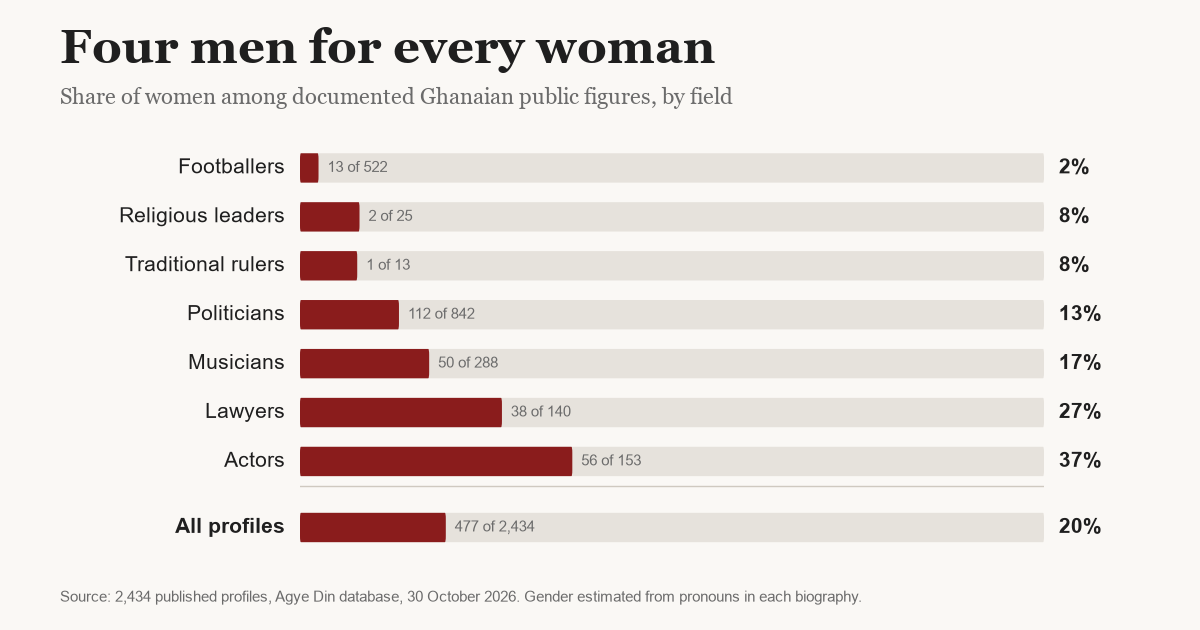
The imbalance is sharpest at the top of religious and traditional life. Of 25 religious leaders in the database, two are women. Of 13 traditional rulers, one is. Among lawyers the share rises to 27 per cent and among actors to 37 per cent. Only in small categories, such as TV presenters, authors and scientists, do women come close to half.
Football and the women’s game
The football figures are the starkest. Most of the 522 footballers were added in a single batch in October 2026, when the squads of every Ghana Premier League club were recorded with their positions, dates of birth and career histories. That information was available because statistics providers track the men’s league match by match.
The women’s game receives far less of that coverage, and it shows. The same month, the Black Maidens, Ghana’s under-17 women’s team, reached the quarter-finals of the FIFA U-17 Women’s World Cup in Morocco. Their coach, Joe Nana Adarkwa, has a profile. The players who got them there are far harder to find in any public record.
Accra at the centre
Geography is the second gap. Of the 1,755 profiles where a home region is recorded, 611, or 35 per cent, list Greater Accra. The region held 17.7 per cent of Ghana’s population at the 2021 census. Ashanti, with almost exactly the same population, accounts for 322 profiles, or 18 per cent, close to its share.
The north is under-counted. The five northern regions, Northern, Savannah, North East, Upper East and Upper West, were home to about 19 per cent of Ghanaians in 2021. Together they account for 220 profiles, or 12.5 per cent. Savannah has 14 profiles and North East has 20.
Part of the Accra figure reflects migration: many people born in the capital have family roots elsewhere. But the pattern also tracks where Ghana’s newsrooms, record labels, studios and corporate headquarters are, and so where public lives are most likely to be reported.
The missing generations
Time is the third gap. Only 84 people in the database were born before 1940, the generation that fought for independence and built the first institutions of the new state. By contrast, 363 were born after 2000, most of them young footballers and musicians whose careers are logged in real time online.
The oldest living person in the database is Sheikh Osmanu Nuhu Sharubutu, the National Chief Imam, born in 1919. Many of his contemporaries survive in the record only in books and archives that have never been digitised, and so remain invisible to anyone searching online.
Why the gaps persist
A database of public figures can only be as broad as its sources. Agye Din’s editorial policy, like that of most reference works, requires every profile to rest on published material: news reports, official statements, verified social accounts or existing encyclopaedia entries. A woman who has led a market association for 30 years, or a northern chief who has never been interviewed by a national paper, is hard to document with confidence.
That turns gaps in coverage into gaps in memory. When Ghanaian newsrooms write about men in Accra, the record fills with men in Accra. When award schemes and statistics providers track one league and not another, only one league gets remembered.
The fix starts upstream: with newsrooms that cover the regions, sports desks that report the women’s league, and families and institutions that publish the life stories of the people they honour. For now, Ghana’s written record of its public life is, four times out of five, a record of men.