

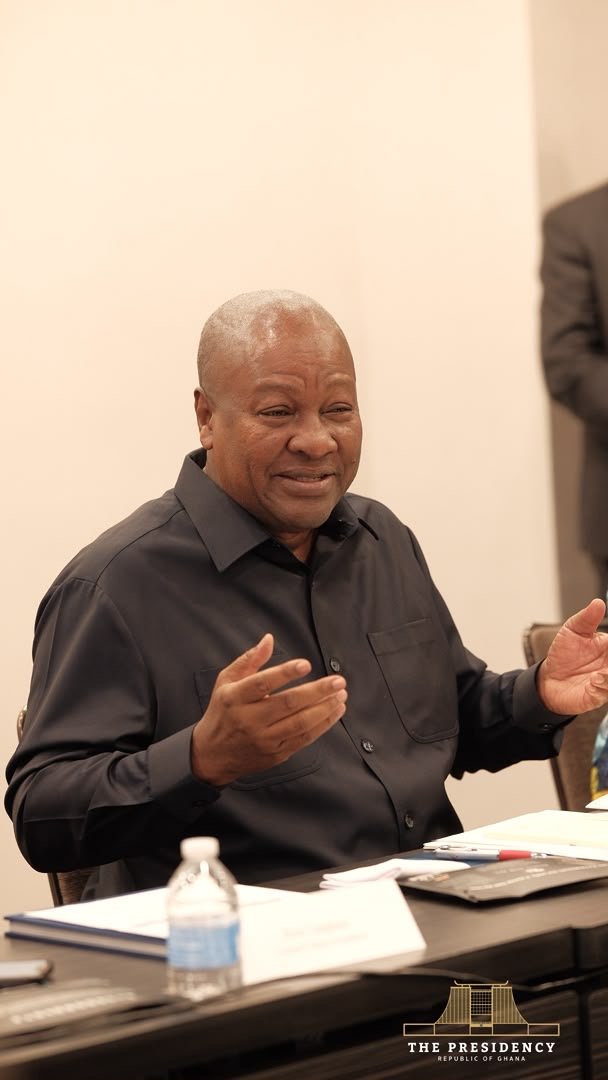
President John Dramani Mahama has called for the immediate implementation of recommendations under the Accra Reset, warning that the initiative must not become another global agenda that ends with declarations without tangible results.
“We are now moving from design to execution. Too often, visionary ideas are born with great fanfare, only to die quietly in New York’s diplomatic corridors. We will not let that happen to the Accra Reset,” he said.
President Mahama made the remarks on Monday, September 21, 2026, at a high-level Accra Reset event held on the sidelines of the 81st United Nations General Assembly in New York.
He was launching the final report of the Accra Reset High-Level Panel, titled A Sovereign Future for Health, which contains five proposed political shifts and 10 recommendations for reforming global health governance.
‘No ownership without control’
A central message of the report is that countries should have greater control over the decisions, financing and resources that shape their development and health systems.
President Mahama described this principle as “No Ownership Without Control”, arguing that countries in the Global South have often been expected to take responsibility for development outcomes while having limited influence over the decisions behind them.
“For decades, nations of the Global South have been asked to own the results of health and development programmes, while others retain the control,” he said.
He, however, stressed that greater control must be matched with accountability.
According to him, transferring power from international institutions to national governments would not automatically create sovereignty if domestic institutions remain unaccountable.
“If we demand control, we must earn it through uncompromising domestic accountability,” he said.
From recommendations to implementation
President Mahama said Ghana and the Accra Reset Presidential Council would engage governments, global health institutions, development finance organisations, philanthropies and private-sector partners to translate the recommendations into country-level agreements.
The report proposes measures including stronger domestic health financing, regional cooperation, local pharmaceutical and health manufacturing, improved procurement systems and independent accountability mechanisms.
He said partnerships would also be pursued with institutions across Africa, India, Indonesia and the Gulf to strengthen research, regulation, manufacturing and distribution networks.
The President stressed that the agenda was not intended to isolate the Global South from the rest of the world.
“We are seeking pragmatic interdependence: a mature, equal partnership where we see one another as equals,” he said.
President Mahama said health was deliberately chosen as the first major area of focus because of its direct impact on people’s lives.
He pointed to maternal and child health as an immediate test of whether the proposed reforms could produce measurable results.
He also linked the Accra Reset to the Mother Africa initiative and the Business United for Mothers, Babies and Youth (BUMBY) campaign, which are focused on improving maternal and child survival.
The President said Ghana’s expected assumption of the African Union chairmanship in 2027 would provide an opportunity to bring the Accra Reset agenda into wider continental policy discussions.
“As Ghana prepares to assume the Chairmanship of the African Union in 2027, we will carry this Reset agenda into the heart of Africa’s collective policy framework,” he said.
President Mahama formally launched A Sovereign Future for Health on behalf of the Presidential Council and said the responsibility had now shifted from the panel to governments and partners to implement its recommendations.
“The Panel has completed its assignment. Now, the responsibility falls on us to deliver its promise,” he said.