

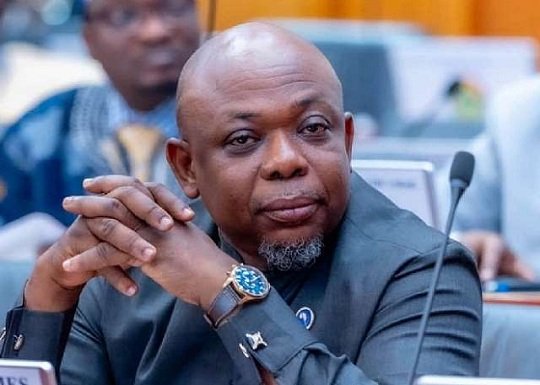
Majority Leader and Member of Parliament for Builsa North, James Agalga, has said the Narcotics Control Commission (NACOC) faced significant institutional and operational constraints before 2025, including limited access to port inspection activities, the absence of a dedicated court for narcotics-related cases and inadequate logistics.
Addressing a parliamentary press conference on the drug situation in Ghana on Thursday, September 24, 2026,, Mr Agalga said the Commission had, since 2018, no longer been part of mandatory joint inspections at the Tema Port, which he argued weakened the country’s profiling, screening and interdiction chain. He also said narcotics cases were for years prosecuted through the regular criminal justice system, contributing to delays and backlogs.
According to him, NACOC was also under-staffed and under-equipped, with fewer than 1,500 personnel nationwide before 2025 and fewer than 10 district commands. He said the Commission lacked adequate vehicles, in-house forensic capabilities and modern intelligence and digital investigation tools needed to effectively respond to increasingly sophisticated narcotics networks.
Mr Agalga said the government had since taken steps to strengthen NACOC, including establishing a dedicated court for narcotics offences, training 495 new officers in 2025 and approving the recruitment of an additional 1,200 personnel.
He further said NACOC’s district commands had increased from fewer than 10 to 77, giving the Commission a presence across all 16 regions, while 35 operational vehicles had also been supplied. A dedicated forensic laboratory is also under construction, alongside the deployment of modern intelligence and digital investigation tools.
The Majority Leader said the institutional changes had been accompanied by increased enforcement activity. He cited NACOC records showing 217 arrests across 165 cases in 2025, compared with 73 arrests in 2024, as well as the seizure of 1,497.75 kilogrammes of narcotic substances and more than five million tramadol tablets.
He, however, acknowledged that challenges remained, particularly in technology, infrastructure and specialist resources. He called for stronger inter-agency cooperation and improved port security measures, including modern detection systems, access to relevant cargo information and closer coordination among NACOC, the Ghana Revenue Authority, the Ghana Ports and Harbours Authority, the Police Service and other security agencies.