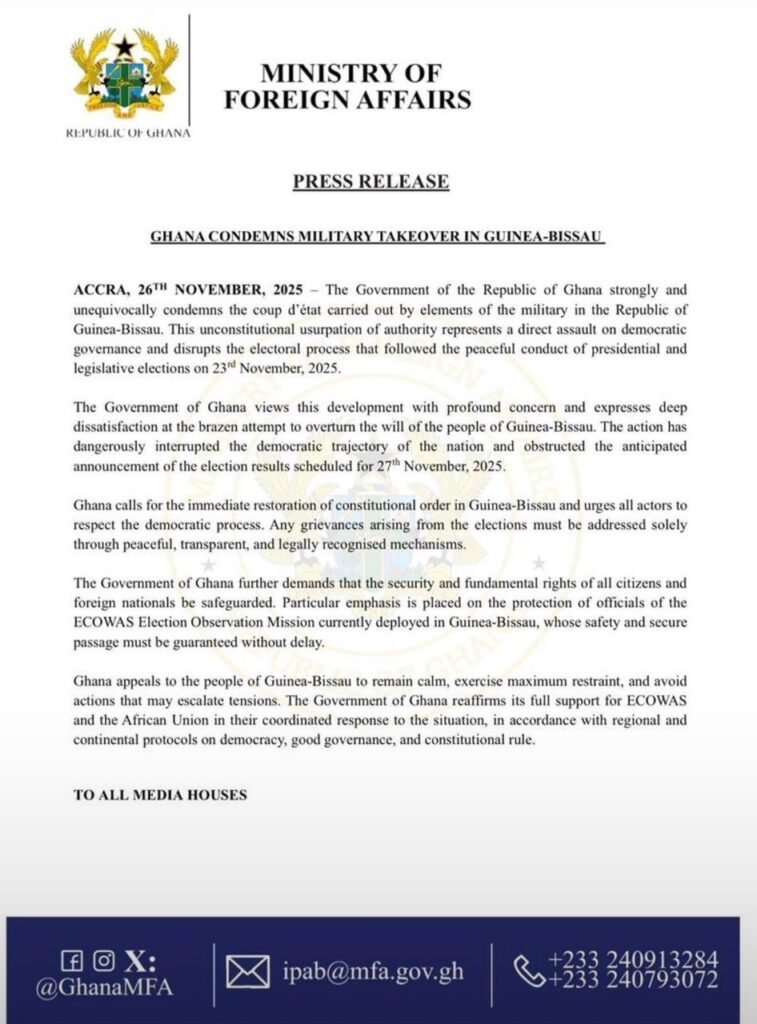
The Government of Ghana has condemned the military takeover in Guinea-Bissau, describing it as an “unconstitutional usurpation of authority” that disrupts the country’s democratic process.
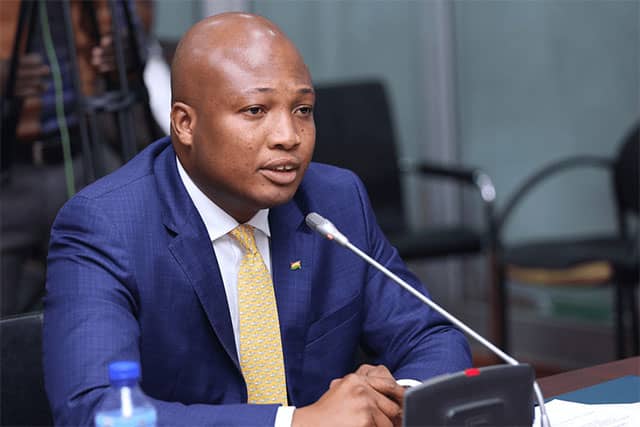
In a press release issued on Wednesday, November 26, 2025, by the Ministry of Foreign Affairs, Samuel Okudzeto Ablakwa, Ghana expressed “profound concern” over the coup d’état carried out by elements of the Guinea-Bissau military, which has interrupted the electoral process following the peaceful presidential and legislative elections held on November 23, 2025.
The statement noted that the action has obstructed the anticipated announcement of election results, originally scheduled for Thursday, November 27, 2025, and called for the immediate restoration of constitutional order.
“Ghana calls for the immediate restoration of constitutional order in Guinea-Bissau and urges all actors to respect the democratic process. Any grievances arising from the elections must be addressed solely through peaceful, transparent, and legally recognised mechanisms,” the release stated.
The government further demanded the safeguarding of the security and fundamental rights of all citizens and foreign nationals, with particular emphasis on the protection of officials from the ECOWAS Election Observation Mission deployed in the country.
Ghana appealed to the people of Guinea-Bissau to remain calm and exercise restraint to avoid escalating tensions, while reaffirming its full support for the Economic Community of West African States (ECOWAS) and the African Union in their coordinated response to the crisis, in line with regional and continental protocols on democracy and good governance.
The military takeover in Guinea-Bissau unfolded on Wednesday amid reports of gunfire near the presidential palace and the National Electoral Commission headquarters in the capital, Bissau.
Brigadier General Denis N’Canha, head of the military office of the presidency, appeared on state television to announce the formation of a “High Military Command for the Restoration of Order,” suspending the electoral process, closing borders, and assuming control until further notice.
President Umaro Sissoco Embaló confirmed to French media that he had been deposed and arrested without violence, along with his army chief of staff and several ministers.
Both Embaló and his main rival, Fernando Dias da Costa, had claimed victory in the election prior to the coup.
ECOWAS and the African Union have also voiced deep concern over the developments, calling for the release of arrested election officials and urging a swift return to constitutional rule.
Guinea-Bissau, one of the world’s poorest nations with a population of under two million, has a history of political instability, having experienced at least nine coups or attempted coups since gaining independence from Portugal in 1974.
The country is also notorious as a transit hub for cocaine trafficking from Latin America to Europe.