Our priority is not to simply extract and export raw materials – Deputy Lands Minister pitches Ghana’s mining vision to Chinese investors
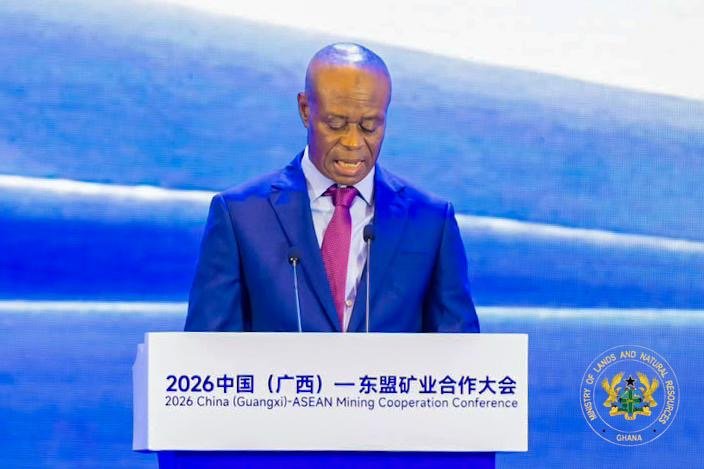
Ghana has challenged Chinese investors and industry players to look beyond mineral extraction and partner the country in building a mining industry driven by local processing, technology and industrial development.
Deputy Minister for Lands and Natural Resources, Yusif Sulemana, made the call at the 2026 China (Guangxi)-ASEAN Mining Cooperation Conference in Nanning, China, where he outlined Ghana’s vision of transforming its mineral wealth into lasting economic benefits.
Delivering Ghana’s address, Sulemana said the country’s ambition was no longer centred on extracting and exporting raw minerals, but on building the capacity to process its resources locally, create jobs, develop skills and retain greater value within the domestic economy.
He cited President John Dramani Mahama’s directive at the Mining in Motion Summit to end the export of raw minerals by 2030 as a major step towards advancing the country’s beneficiation agenda.
Sulemana highlighted Ghana’s rich deposits of gold, bauxite, iron ore, lithium, graphite and salt, alongside its position as Africa’s leading gold producer and the world’s sixth-largest. He assured prospective investors that Ghana’s mining industry operates within established legal, regulatory and institutional frameworks, with the Ghana Geological Survey Authority (GGSA) providing geological information to guide exploration and the Minerals Commission responsible for regulating the sector.
Drawing on China’s experience in mining technology, equipment manufacturing, geological services and mineral processing, the Deputy Minister identified five priority areas for collaboration: geological data and exploration, digital mining and artificial intelligence, mineral processing and value addition, skills and institutional development, and responsible and sustainable mining.
He also emphasised the need for cooperation in mine monitoring, environmental rehabilitation, pollution prevention and improved management of water and mine waste.
Sulemana reiterated Ghana’s invitation to Chinese companies and institutions, saying the country was ready to work with partners who shared its vision of a modern, responsible and value-driven mining industry.
He urged investors to use the conference as a starting point for concrete discussions with Ghanaian institutions and industry players, expressing confidence that combining Ghana’s mineral resources and development priorities with China’s technological expertise and industrial capabilities could unlock significant opportunities for both countries.
“Ghana is open for business,” he affirmed, calling for partnerships that are commercially sound, environmentally responsible and capable of delivering lasting benefits.
Following the conference, the Deputy Minister also delivered the opening remarks at the Ghana National Mining Promotion Session, which provided another platform to showcase the country’s mineral potential and attract investors to opportunities across the mining value chain.
The session featured presentations by the Director-General of the Ghana Geological Survey Authority, Prosper Akaba; Chief Executive Officer of the Minerals Income Investment Fund (MIIF), Justina Nelson; and Deputy Chief Executive of the Minerals Commission responsible for Small-Scale and Industrial Mining, Maxwell Klu.
They outlined investment prospects, geological opportunities, the country’s mineral development priorities and the institutional support available to prospective investors.
The presentations were aimed at giving the international investment community a clearer picture of Ghana’s mining landscape and opening the door to meaningful business engagements and strategic partnerships.