

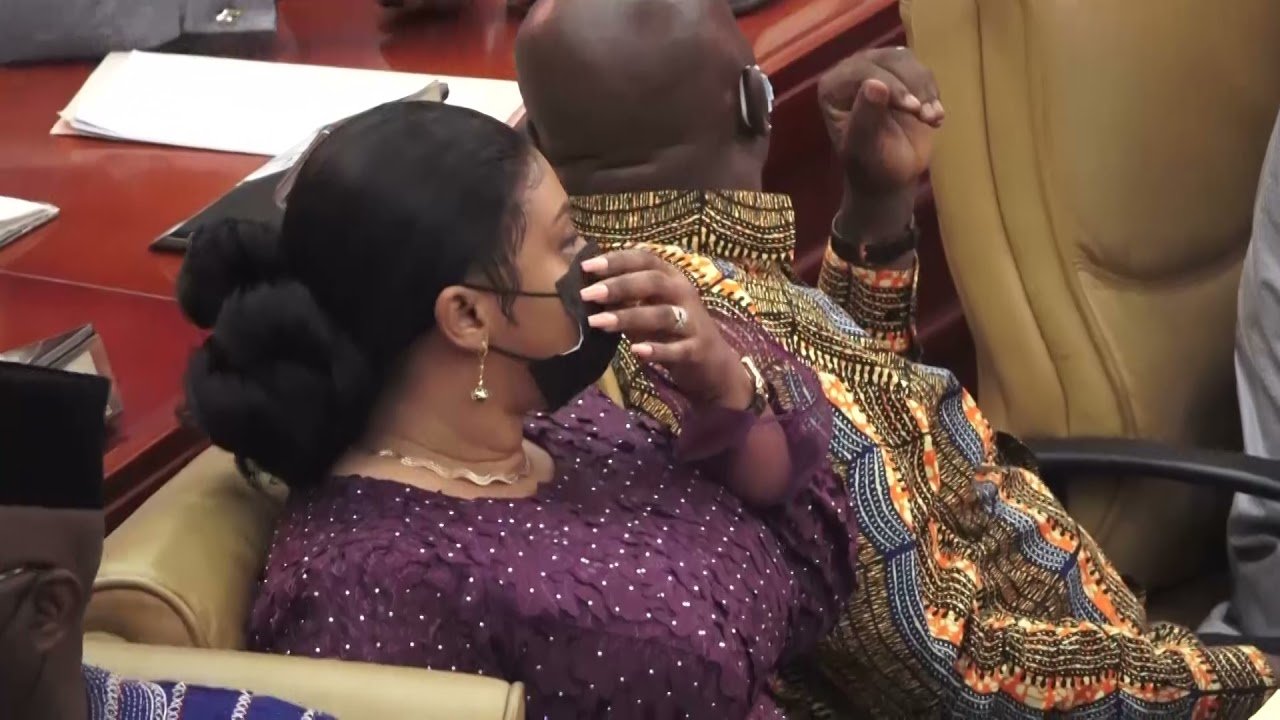
Three persons have petitioned the Criminal Investigations Department (CID) of the Ghana Police Service to investigate the alleged impersonation of former Dome-Kwabenya MP Sarah Adwoa Safo in Parliament.
The petitioners are Emmanuel Kotin, Godwin Ebo Buckman and Dr Ramzy Innusah.
They are asking the police to establish whether Adwoa Safo was the person seen in Parliament during the approval of the 2022 Budget in November 2021.
The petitioners said the investigation should either lead to the prosecution of anyone found to have impersonated the former MP or exonerate Adwoa Safo if it is established that she was indeed the person seen in Parliament.
Speaking on TV3’s Ghana Tonight on Tuesday, September 15, 2026, one of the petitioners, Godwin Ebo Buckman, said the move was intended to bring closure to the controversy, which has resurfaced several times over the years.
“Since the allegation started coming out, every now and then, this issue comes up for public discussion, so it is important this is settled once and for all,” he said.
Mr Buckman said the recurring nature of the controversy raised concerns about the integrity of Parliament, the country’s democracy and the individuals involved.
He said the petitioners had therefore decided to move the matter beyond public allegations and have the appropriate state institution investigate it.
“We decided to escalate the matter from the level of allegation to investigation to ascertain whether the lady in the video was indeed Adwoa Safo,” he explained.
How the controversy started
The controversy dates back to 2021 when Adwoa Safo, who was then the MP for Dome-Kwabenya and Minister for Gender, Children and Social Protection, sought leave of absence from Parliament for personal reasons.
Then-President Nana Addo Dankwa Akufo-Addo extended her leave in October 2021 and directed the then Minister of Sanitation and Water Resources, Cecilia Abena Dapaah, to act as caretaker.
Her prolonged absence subsequently became a major political issue, particularly in early 2022.
The controversy intensified after a masked female MP was seen behind the then Majority Leader during parliamentary proceedings surrounding the approval of the 2022 Budget in November 2021.
The development led to claims that Adwoa Safo had been impersonated during the proceedings.
Parliament had initially rejected the 2022 Budget on November 26, 2021, after the then Minority caucus walked out of the chamber over a dispute concerning the Speaker’s ruling on the vote.
The Budget was subsequently reconsidered and approved three days later after the Minority returned to the chamber.
At the time, then-Assin Central MP Kennedy Ohene Agyapong defended Adwoa Safo, saying she had supported the Electronic Transactions Levy (E-Levy) and was being victimised by some elements within the New Patriotic Party (NPP).
Then-Minority Leader Haruna Iddrisu also questioned whether the Majority had the required numbers to approve the Budget, including the presence of Adwoa Safo.
Adwoa Safo later rejected the impersonation claims, insisting that she was present in Parliament and participated in the vote on the motion for the approval of the Budget.
Despite her denial, Mr Buckman said questions surrounding the identity of the woman seen in the video remained unresolved, prompting the petitioners to seek a formal investigation.
He said the passage of time should not prevent the security agencies from establishing what happened.
“With passage of time, we still want to believe that the security agencies still have what it takes to be able to unravel the truth or otherwise about this whole issue,” he said.
According to him, the outcome of the investigation would provide clarity and allow the matter to be settled.
“If we are able to establish that indeed the lady in that video is not Adwoa Safo, then what has to be done according to law would be done. If, on the other hand, it happens that the lady was Adwoa Safo, then the lady can be put to rest,” he added.
The petitioners are therefore asking the CID to investigate the circumstances surrounding the incident and establish the identity of the person seen in Parliament.