

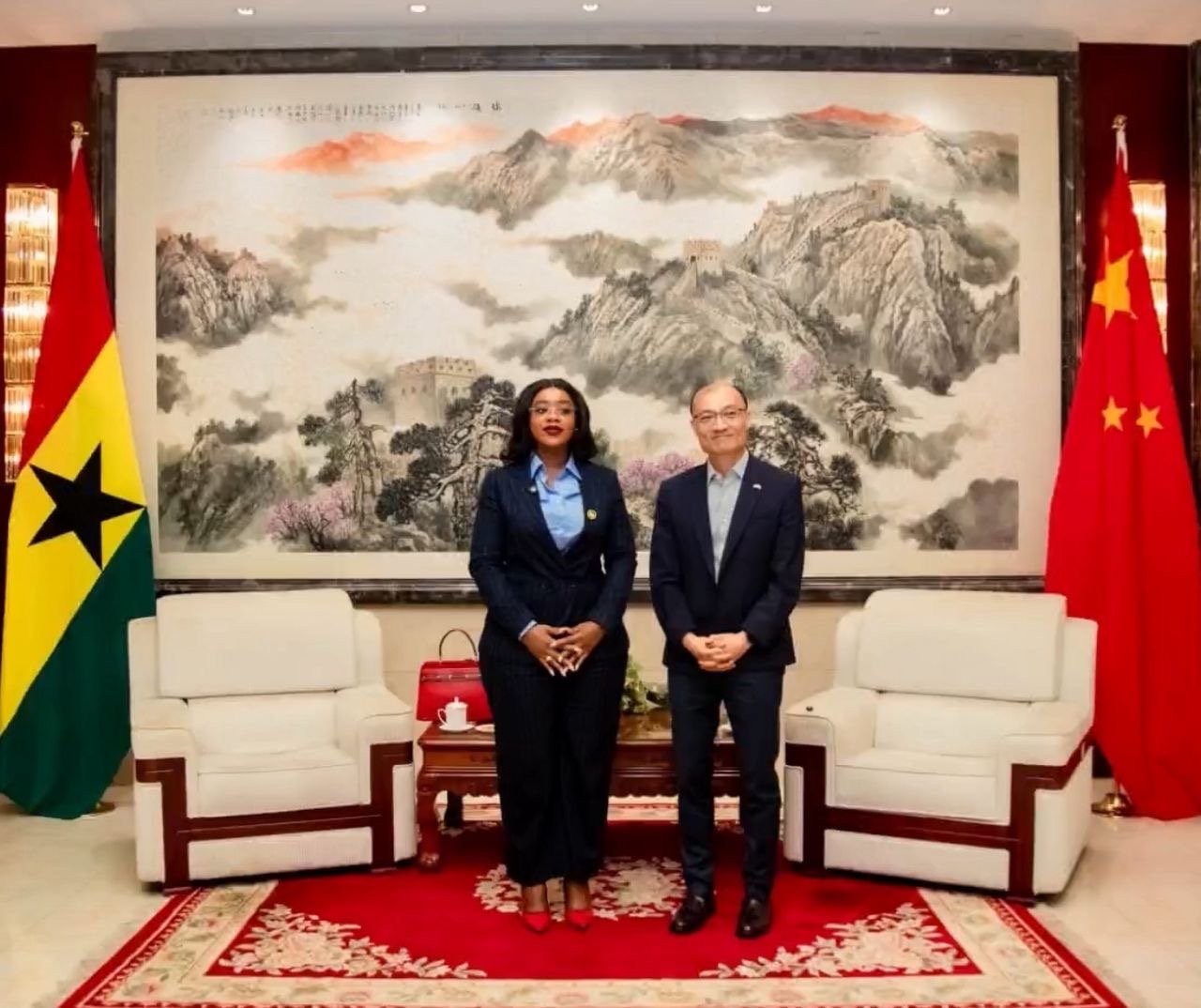
The Chinese Ambassador to Ghana, Tong Defa, has reaffirmed China’s firm commitment to supporting Ghana’s agricultural sector, with a focus on making agribusiness appealing to the youth, expanding apprenticeship opportunities, and enhancing technology-driven skills training.
The Ambassador made the pledge during a courtesy call on him by the Member of Parliament for Sunyani West Constituency, Millicent Yeboah Amankwah on Tuesday, December 16, 2025.
Ambassador Tong Defa emphasised Ghana’s strategic importance to China, describing the West African nation as China’s largest trading partner on the continent. He disclosed that bilateral trade between the two countries reached approximately US$11.8 billion in 2024.
In her address, the Sunyani West MP highlighted ongoing development projects in her constituency, particularly those centred on agriculture and skills development as key drivers for improving livelihoods and raising living standards.
A key focus of the discussion was her constituency’s skills development initiative, aimed at enrolling thousands of young people into apprenticeship programmes. Madam Yeboah Amankwah described apprenticeship as a vital component of Ghana’s micro, small and medium-scale enterprises (MSMEs), which play a significant role in the economy, especially in the informal sector.
The programme has been structured into seven clusters, covering trades such as hairdressing and dressmaking, and is supported by the distribution of thousands of industrial sewing machines and other vocational materials.
To accommodate trainees’ work schedules, the training has been designed with flexibility in mind. Additionally, to create a ready market for the beneficiaries, the MP said she has engaged headteachers of the six senior high schools in the constituency to have school uniforms produced by the apprentices.
Agriculture dominated much of the conversation, with the MP stressing the need to shift perceptions that farming is unappealing or reserved only for older generations. She noted that many young Ghanaians still prefer white-collar or public sector jobs, overlooking the immense opportunities along the agricultural value chain.
“We want to make agriculture attractive. There is a different perception when you say you are into agriculture, and many young people prefer white-collar jobs in public institutions, forgetting that agriculture has huge potential. It supports livelihoods and remains the backbone of the country,” she stated.
Ambassador Tong Defa also touched on strengthening rural healthcare, citing China’s “barefoot doctors” model – where community health workers are trained and deployed to rural areas – as a potential approach for Ghana.
On technological training, the Ambassador revealed that talks have commenced with the Minister of Education, Haruna Iddrisu, to revive existing agreements that would allow Ghanaian youth to access advanced technical training in China, especially as the world moves towards the Fourth Industrial Revolution.
He further highlighted Ghana’s strong export potential in cashew nuts, which enjoy high demand in China, adding that several Chinese investors are interested in Ghana’s agribusiness sector and are eager to take advantage of the zero-tariff regime on Ghanaian exports to China.
The discussions build on previous Chinese support in the Sunyani area, notably the China-Ghana Agricultural Luban Workshop (CGALW) at the University of Energy and Natural Resources (UENR). The facility offers students practical training in modern agricultural technologies and skills.
Sunyani is one of the few cities worldwide hosting a Luban Workshop, a Chinese international vocational training programme now operating in about 19 countries, including Thailand, India, Indonesia, Portugal, Egypt, Djibouti, Ethiopia, and Kenya. Named after the ancient Chinese craftsman Lu Ban, the initiative is supported by China’s Ministry of Education to promote skills transfer, innovation, and youth employability.
Ambassador Defa reiterated China’s readiness to align its cooperation with Ghana’s development priorities, pointing to a recent bilateral economic and technical cooperation agreement and China’s zero-tariff treatment for all tariff lines from African countries, including Ghana.
China continues to be Ghana’s largest trading partner and a major source of foreign direct investment.