

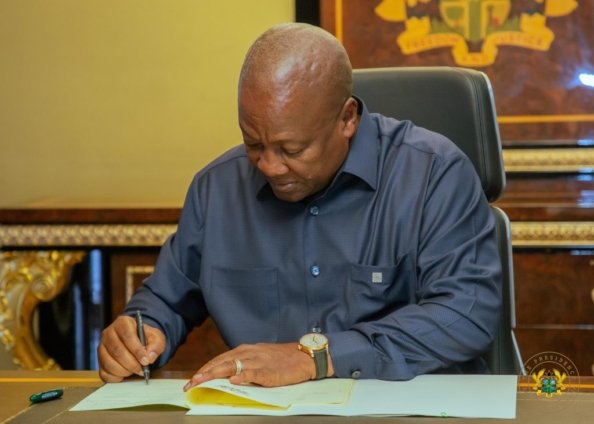
President John Dramani Mahama has signed the Legal Education Reform Bill (2025) into law, effectively ending the Ghana School of Law’s decades-long monopoly over professional legal education in the country.
The new legislation paves the way for accredited universities to offer professional law programmes, a long-awaited reform aimed at expanding access to legal education while maintaining high standards.
Speaking during the signing ceremony on Monday, President Mahama explained that the Act seeks to balance quality with increased opportunity for aspiring lawyers.
“Regulate legal education and ensure the highest standards in terms of legal education, but also to open up a space for more opportunities for legal education in Ghana,” he said.
“This particular act has been one that many aspiring lawyers have been looking up to. So it’ll be fine,” the president added.
Since its establishment in 1958, the Ghana School of Law has been the only institution authorised to provide the professional law course required for admission to the Ghana Bar. Over the years, the arrangement has faced strong criticism for creating a severe bottleneck, leaving hundreds of qualified LLB graduates without placement annually.
Campaigners and legal educators have consistently argued that the monopoly limited access to the legal profession and called for reforms to allow other qualified institutions to train lawyers.
Under the new law, universities that meet the accreditation requirements set by the General Legal Council and other relevant regulatory bodies will now be permitted to run professional legal training programmes. This is expected to significantly expand capacity and create more opportunities for law graduates across the country.