

Cabinet has endorsed a comprehensive review of the Minerals and Mining Act, 2006 (Act 703), and forwarded it to Parliament for approval as the government moves to strengthen regulation of the country’s mineral resources and reposition the sector for national development.
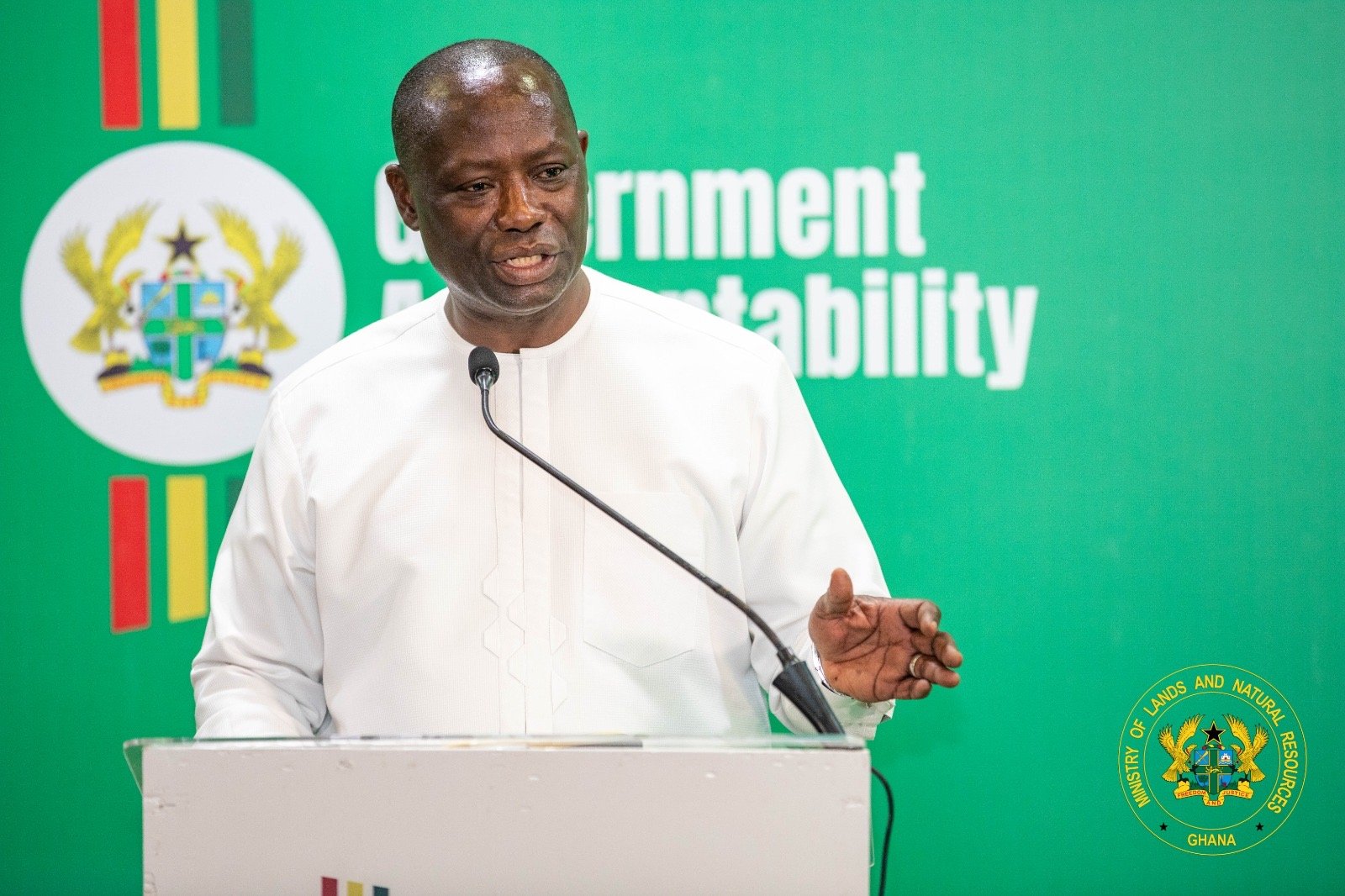
Speaking on Wednesday, July 15, 2026, at the Government Accountability Series held at the Presidency in Accra, Minister for Lands and Natural Resources Emmanuel Armah-Kofi Buah presented an account of his Ministry’s performance for the first half of the year, covering the mining, forestry and lands sub-sectors.
Buah said Act 703, which has been in force for two decades, was reviewed following stakeholder consultations and endorsed by Cabinet for transmission to Parliament.
He said the revised bill introduces district mining committees as the entry point for licensing, creates a new medium-scale mining category, and abolishes the reconnaissance licence in favour of a single prospecting licence capped at five years. Mining leases will now be fixed at a maximum of 20 years, and every lease will carry a mandatory community development agreement.
“The revised Bill provides an updated, coherent and forward-looking legal regime to ensure that mining contributes immensely to national development,” he said.
The Minister added that Cabinet has also approved a revised Minerals and Mining Policy, first developed in 2014, to strengthen local content and domestic value addition in the sector, alongside the Minerals and Mining (Royalties) Regulations, 2025 (L.I. 2517), which introduces a sliding-scale royalty regime tied to commodity price cycles.
“This self-adjusting mechanism offers greater predictability to investors than a rigid fixed rate vulnerable to low-price cycles,” Buah explained.
On enforcement, Buah disclosed that the National Anti-Illegal Mining Operations Secretariat (NAIMOS) executed 200 operations across 53 districts in six endemic regions between January and June, recording a strike rate of 84.1 percent.
He revealed that the operations led to the arrest of 207 suspects, including 46 foreign nationals, and the seizure or destruction of 78 excavators, 2,800 chanfangs and 1,244 makeshift mining structures.
“Our rivers are not for sale. Our forests are not expendable. Our mineral wealth is a sacred national inheritance that we have a duty to protect. Let me be clear, the era of impunity is over,” the Minister emphasized.
On reclamation, Buah reported that 1,535 acres of degraded land in the Ashanti Region had been restored in partnership with the private sector, with a further 1,500 acres targeted by the end of the year. Government is separately reclaiming 960 acres across the country.
He added that government has launched the Strategic Land Administration Reform Project (SLARP), a nationally owned programme aimed at modernising and decentralising Ghana’s land administration system through eight components, including digitisation of the Lands Commission, systematic titling and a national cadastre, boundary demarcation, and strengthening of customary land secretariats.
The Ministry has also revised the Public Land Application Form (Form 5), proposed a new premium framework to align state land values with market prices, and established a Public Land Protection Task Force to guard against encroachment.
“These reforms are intended to ensure that state land transactions are done in a more transparent, accountable and efficient manner,” Buah said.
He added that the Office of the Administrator of Stool Lands (OASL) has mobilised GH₵265.61 million so far, representing about 75.48 percent of its annual target of GH₵351.88 million, and opened four new district offices during the period under review.
On forestry, the Minister said about 31 million seedlings were planted in 2025 under the Tree for Life Restoration Initiative, restoring roughly 23,600 hectares of degraded land, with a fresh 30-million-seedling target running from June this year.
He announced that Cabinet, on June 24, 2026, revoked the executive instruments that had altered the status of the Achimota Forest, restoring it fully as a forest reserve, and noted that Ghana has issued 411 Forest Law Enforcement Governance and Trade (FLEGT) licences so far in 2026.
Buah assured citizens that the sector would continue working to restore Ghana’s lands, forests and river bodies affected by illegal mining and appealed for national unity in protecting the country’s natural resources.