

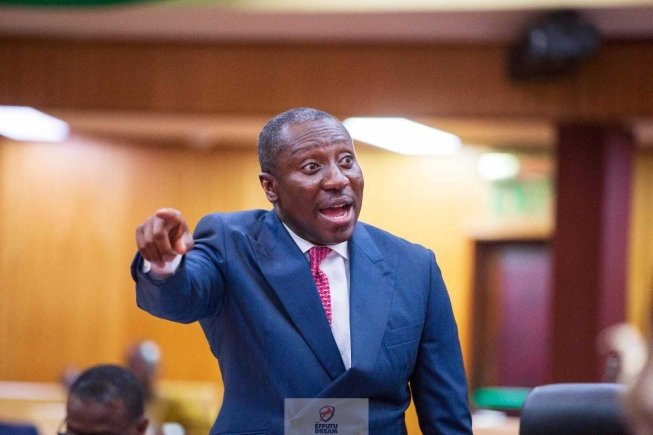
Democracy and Development Fellow at the Centre for Democratic Development (CDD-Ghana), Dr John Osae-Kwapong, has warned that fresh allegations involving Minority Leader Alexander Afenyo-Markin could further erode public confidence in Parliament.
Speaking on Joy News’ PM Express on Tuesday, Dr Osae-Kwapong said the controversy should not be viewed solely through the conduct of the individual at the centre of the allegations, but also in terms of its broader implications for Parliament as Ghana’s key representative institution.
“When you look beyond the individual that has triggered this broader conversation that we are having, it really goes to the heart of how we perceive the institution of Parliament, the key representative institution of the people,” he said.
His comments follow a public dispute between Mr Afenyo-Markin and GoldBod Chief Executive Officer Sammy Gyamfi.
Mr Gyamfi accused the Minority Leader of being an “extortionist” and alleged that he was seeking to pressure GoldBod. Mr Afenyo-Markin has rejected the allegation and threatened legal action, turning the exchange into a wider political and legal dispute.
Dr Osae-Kwapong said the allegations must be considered against the backdrop of existing public perceptions about Parliament, citing Afrobarometer findings on declining trust in the institution and perceptions of corruption.
“When an institution like Parliament is facing what I call a crisis of confidence, very low trust and high perceptions of corruption, when these things come out, and they are alleged, right? Because at this point they are allegations,” he said.
He warned that such allegations could reinforce negative perceptions already held by sections of the public.
“But when these allegations emerge, what they do is, in the eyes of the public, it goes to reinforce an already held perception about the country’s key democratic representative institution in our democracy architecture.”
According to him, continued erosion of public confidence could have serious consequences for Ghana’s democracy.
“And when that confidence and that trust continues to erode, a time would come where citizens may lose total faith in, you know, that institution,” he said.
Dr Osae-Kwapong stressed that such an outcome would be particularly worrying given Parliament’s constitutional role in holding the Executive accountable, providing oversight and making laws on behalf of the people.
“And that doesn’t augur well for our democracy, for those that you expect, for example, to hold the executive accountable, to provide oversight, to make laws on our behalf, etc.”
He therefore urged the public and stakeholders to look beyond Mr Afenyo-Markin and the immediate controversy and consider its implications for Parliament as an institution.
“So, for me, that is really the worrying thing about these allegations: what it does to Parliament itself as an institution at a time when it is already not in good standing in the eyes of the public.”
The dispute between Mr Gyamfi and Mr Afenyo-Markin has intensified scrutiny of the relationship between public officials, Parliament and institutions such as GoldBod.
Dr Osae-Kwapong’s warning highlights concerns that, beyond the competing claims and threatened legal action, such controversies could further weaken citizens’ trust in Parliament and its ability to perform its constitutional functions.