

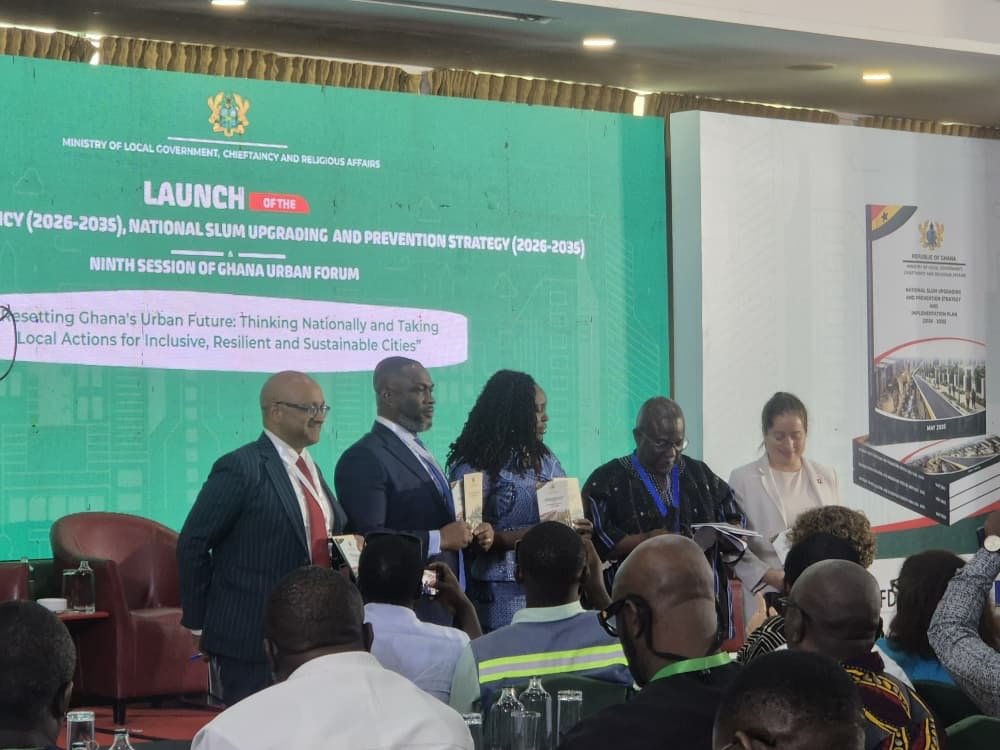
The government has launched a new 10-year National Urban Policy and a National Slum Upgrading and Prevention Strategy aimed at addressing challenges confronting Ghana’s urban areas, including flooding, housing shortages, congestion and unplanned settlements.
The National Urban Policy (2026–2035) and the National Slum Upgrading and Prevention Strategy (2026–2035) were launched on Tuesday, July 28, 2026, at the opening of the 9th Ghana Urban Forum in Accra.
The forum was held under the theme: “Resetting Ghana’s Urban Future: Thinking Nationally and Taking Local Actions for Inclusive, Resilient and Sustainable Cities.”
A keynote address delivered on behalf of President John Mahama by the Board Chairman of the National Development Planning Commission (NDPC), Dr Nii Moi Thompson, revealed that Ghana’s first National Urban Policy, introduced in 2012, achieved only about half of its intended outcomes.
According to the President, while some progress was recorded in areas such as urban safety, spatial planning and environmental awareness, significant gaps remained in affordable housing, urban financing, research, data systems and institutional coordination.
“The gap between policy and implementation persisted,” the address noted, attributing the shortcomings to weak coordination among institutions, inadequate financing, poor integration of the policy into sectoral plans and budgets, and limited monitoring.
The President further highlighted the rapid growth of Ghana’s urban population, noting that it has increased from about four million people in the 1980s to an estimated 20.4 million in 2026.
He added that by 2030, nearly two out of every three Ghanaians are expected to live in urban areas, requiring stronger planning and investment to manage the country’s urban expansion.
The new National Urban Policy seeks to promote sustainable urban growth through improved land-use planning, climate resilience, better infrastructure financing, affordable housing, digital governance and equitable access to essential services.
Speaking at the launch, Minister for Local Government, Chieftaincy and Religious Affairs, Ahmed Ibrahim, said the National Slum Upgrading and Prevention Strategy would focus on improving conditions in existing informal settlements while preventing the development of new slums.
He urged Metropolitan, Municipal and District Assemblies (MMDAs) to incorporate the two policy frameworks into their development plans and budgets, stressing that their success would depend on effective implementation.
According to him, the ministry would coordinate the implementation, monitoring and evaluation of the policies to ensure they translate into tangible improvements in the lives of citizens.
Meanwhile, Minister for Works, Housing and Water Resources, Kenneth Gilbert Adjei, announced that his ministry had begun reviewing Ghana’s National Housing Policy to align it with the new urban development framework.
He said the revised policy would prioritise affordable housing, climate-responsive settlements, resilient infrastructure and stronger partnerships between government, the private sector and development partners.
The two policy documents are expected to guide Ghana’s urban development agenda from 2026 to 2035, with government hoping they will strengthen urban planning, reduce informal settlements and promote inclusive, resilient and sustainable cities.