

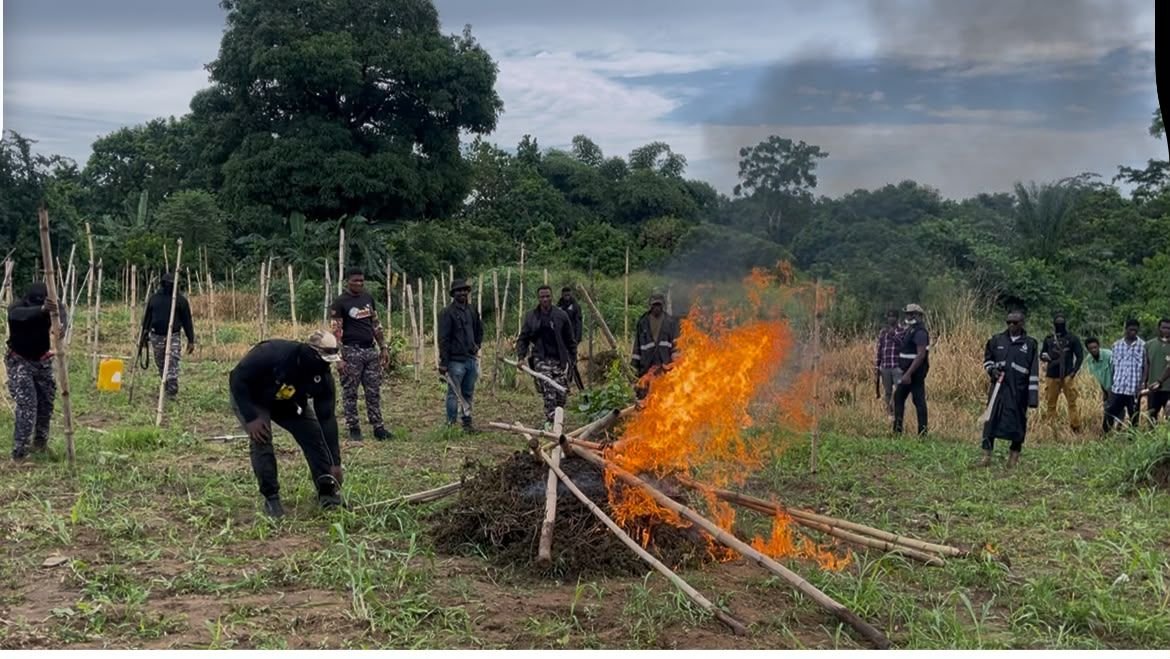
Six suspects have been arrested for allegedly cultivating cannabis on large farms in two communities in the Eastern Region.
The suspects, aged between 25 and 32, are currently in police custody assisting with investigations and are expected to be prosecuted.
The arrests followed a tip-off that led officers from the Police High Risk Operations Directorate to cannabis plantations located at Nsuta Aperade in the Okere District and Nsuta Hasi in the Yilo Krobo Municipality.
According to investigators, more than seven acres of land had been used for the illegal cultivation of cannabis.
Police said accessing the farms required navigating forests, farmlands, rivers and steep slopes, making the locations ideal hideouts for those involved in the illicit activity.
Authorities disclosed that long electrical cables had been extended to the farms to support cultivation activities. Cannabis seedlings were reportedly nurtured in small plastic cups under electric bulbs before being transplanted onto the farms.
Following the arrests, personnel from the Drug Law Enforcement Unit of the Criminal Investigations Department (CID) moved to the sites and destroyed the cannabis farms.
Investigators also discovered structures built on the farms, some fitted with air conditioners and other equipment to facilitate operations.
Speaking to the media, Director of the Police High Risk Operations Training Centre, Superintendent Dr. Samuel Antwi Akomeah, said the operation formed part of efforts to tackle the illegal drug trade at its source.
“The target is the end users, but we may not make any headway unless we tackle the source, which is the cultivation of cannabis. If they are not planting, the end users will not have access,” he stated.
He revealed that a total of seven acres of cannabis plantations had been identified at Nsuta Aperade and Nsuta Hasi, adding that authorities suspect there are more farms in the area.
Dr. Akomeah warned individuals involved in cannabis cultivation to abandon the practice, stressing that the police would intensify operations to track down offenders.
He further disclosed that preliminary investigations suggest some cultivators process cannabis for clients who allegedly use it in beverages and food products such as sobolo, biscuits and toffees.
According to him, some suspects admitted supplying cannabis to individuals who mix it into local drinks and other consumables, potentially exposing unsuspecting members of the public to the substance.
Police say the illegal trade remains highly lucrative, with a single bag of cannabis capable of generating thousands of Ghana cedis, increasing concerns over the possible exploitation of children and vulnerable persons.
Under the Narcotics Control Commission Act, 2020 (Act 1019), the cultivation of cannabis is prohibited unless carried out under a valid licence for approved industrial or medicinal purposes with a THC content of not more than 0.3 percent.
Cannabis plants exceeding the prescribed THC limit remain illegal to cultivate, possess or distribute without special ministerial authorisation. Offenders risk arrest and prosecution under Ghanaian law.