

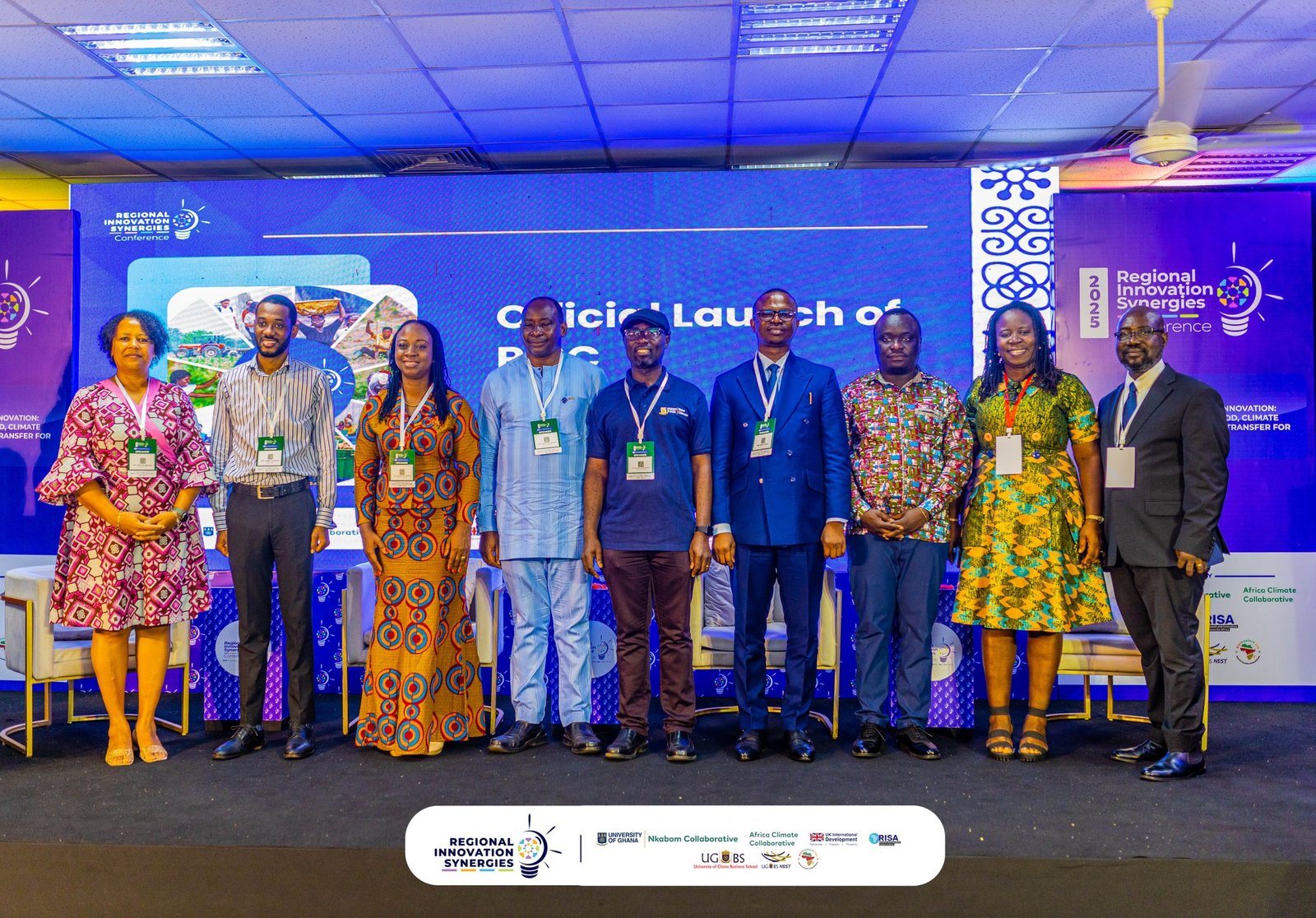
The University of Ghana Business School (UGBS) Innovation and Incubation Hub on Tuesday, 3 December 2025, opened the maiden edition of the Regional Innovation Synergies (RIS) Conference 2025, a two-day gathering aimed at transforming Ghana’s fragmented innovation efforts into a coordinated engine for sustainable national growth.
Held under the theme “Aligning Partnerships for Innovation: Building Synergies in Agri-food, Climate Action and Rural Technology Transfer for Job Creation,” the conference brought together policymakers, development partners, researchers, entrepreneurs, students, and innovation hub leaders to showcase successful initiatives and forge stronger collaborations.
Speaking on behalf of the Vice-Chancellor, Prof. Nana Aba Appiah Amfo, Provost of the College of Humanities, Prof. Joseph Awetori Yaro, officially declared the conference open. He emphasised that Ghana and Africa possess abundant innovative talent but have lacked the necessary synergy and supportive national framework to scale homegrown solutions.
“We are a continent that for too long has been content to have others think for us, innovate for us, create for us,” Prof. Yaro stated. “You cannot have factories when you do not have the innovation to feed them. Let us have innovation first.”
He highlighted several UGBS-led projects, including the UGBS Innovation & Incubation Hub (The NEST), AFA Venture Lab, In-Carbon Project, Africa Climate Collaborative, BRIInG Project, and the British Council-supported THINK Network as living proof that innovation thrives when diverse actors are connected by shared purpose.
Prof. George Acheampong, Project Director and Director of the AFA Venture Lab, explained the rationale behind the conference in his address titled “Why RIS”.
He described RIS 2025 as “a movement toward synergistic innovation” where boundaries between academia, industry, government and community dissolve.
“When Nkabom builds capacity, BRIInG extends it into rural economic systems. Where the Africa Climate Collaborative fosters sustainability, the British Council programme institutionalises learning and enterprise support,” Prof. Acheampong noted, adding that together the initiatives form the architecture of a resilient national innovation ecosystem.
The Chief Executive Officer of the National Entrepreneurship and Innovation Programme (NEIP), Mr. Eric Adjei, who was the Guest of Honour, reaffirmed NEIP’s commitment to supporting entrepreneurs in agri-food processing, climate action, and rural enterprise development.
“Ghana’s economic future depends on our ability to build strong and competitive enterprises,” Mr. Adjei said, praising the University of Ghana’s exceptional performance in NEIP’s recent nationwide training programmes.
In her keynote address, Acting Administrator of the newly established Ghana National Research Fund (GNRF), Prof. Abigail Opoku Mensah, announced that impact-driven research will be the fund’s top priority.
She revealed that GNRF is planning an annual national event to celebrate milestones in Ghana’s innovation journey and urged organisers to deepen alignment with agriculture, climate change, and rural innovation, areas that align with the fund’s proposed thematic priorities.

The conference, which featured exhibitions, showcased tangible outcomes from ongoing projects, including young innovators launching viable agri-food and nutrition enterprises, climate-smart businesses receiving mentorship, and rural communities benefiting from university-developed technologies for food processing and product certification.
The two-day event also featured various sessions, including a National Networking and Regulatory Advocacy Meeting where stakeholders under the Nkabom Initiative came together to pause, reflect, and reconnect on their collective mission.
Through a reflective and collaborative panel, partners assessed progress across the collaborative, examining successes, challenges, and strategic approaches for empowering youth within the agrifood system and entrepreneurship. Discussions also explored how institutions can more holistically support young people to create viable agrifood businesses, strengthen their entrepreneurial capacity, and contribute to food security and sustainable job creation.

Day two of the conference focused on youth enterprise showcasing, networking, and investment readiness. It featured exhibitions, an investor roundtable, and a pitch competition involving 15 youth-led agrifood startups and also marked the first working session to co-create and discuss the West Africa Youth in Agrifood and Nutrition Entrepreneurship (WAYANE) platform.