

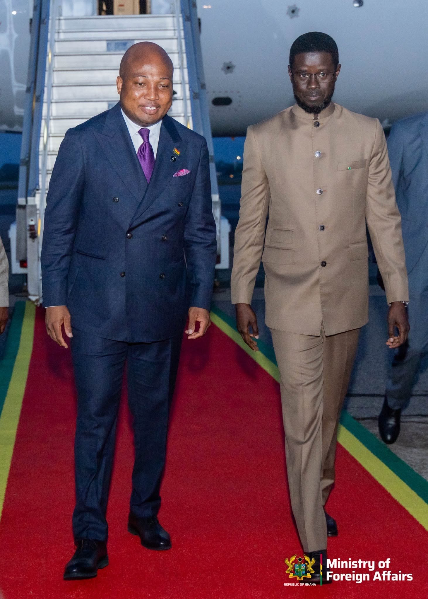
Presidents, prime ministers, parliamentary leaders, ministers and senior government officials from more than 80 countries have gathered in Accra for the Next Steps Conference on Reparatory Justice, a high-level meeting convened by President John Dramani Mahama to advance global efforts towards reparations for the transatlantic slave trade and its lasting effects.
The three-day conference, which runs from June 17 to June 19, 2026, has attracted leaders and representatives from Africa, the Caribbean, the Americas and other parts of the world.
Among the dignitaries attending are the presidents of Senegal, Namibia, Liberia and São Tomé and Príncipe, the Prime Minister of Barbados, the Vice Prime Minister of Equatorial Guinea, the Speaker of the Algerian Parliament, as well as ministers and senior officials from various countries. French President Emmanuel Macron is also expected to participate in the conference.
Speaking on the significance of the gathering, Minister for Foreign Affairs Samuel Okudzeto Ablakwa said the conference is intended to build momentum for a coordinated international approach to reparatory justice.
According to him, the event brings together political leaders, policymakers, academics and advocates to explore pathways for addressing both the historical and contemporary impacts of the transatlantic slave trade.
The conference comes three months after the adoption of United Nations Resolution A/RES/80/250, which declared transatlantic enslavement the gravest crime against humanity.
The landmark resolution has strengthened international recognition of the scale and enduring consequences of the slave trade, while intensifying calls for concrete measures to address historical injustices.
President Mahama, who has positioned Ghana as a leading advocate for global reparatory justice, is expected to use the conference to deepen international cooperation and promote actionable frameworks aimed at advancing reparations and restorative justice.
The conference is expected to conclude with recommendations intended to strengthen international advocacy, promote historical accountability and advance policies addressing the legacy of slavery and colonial exploitation.