

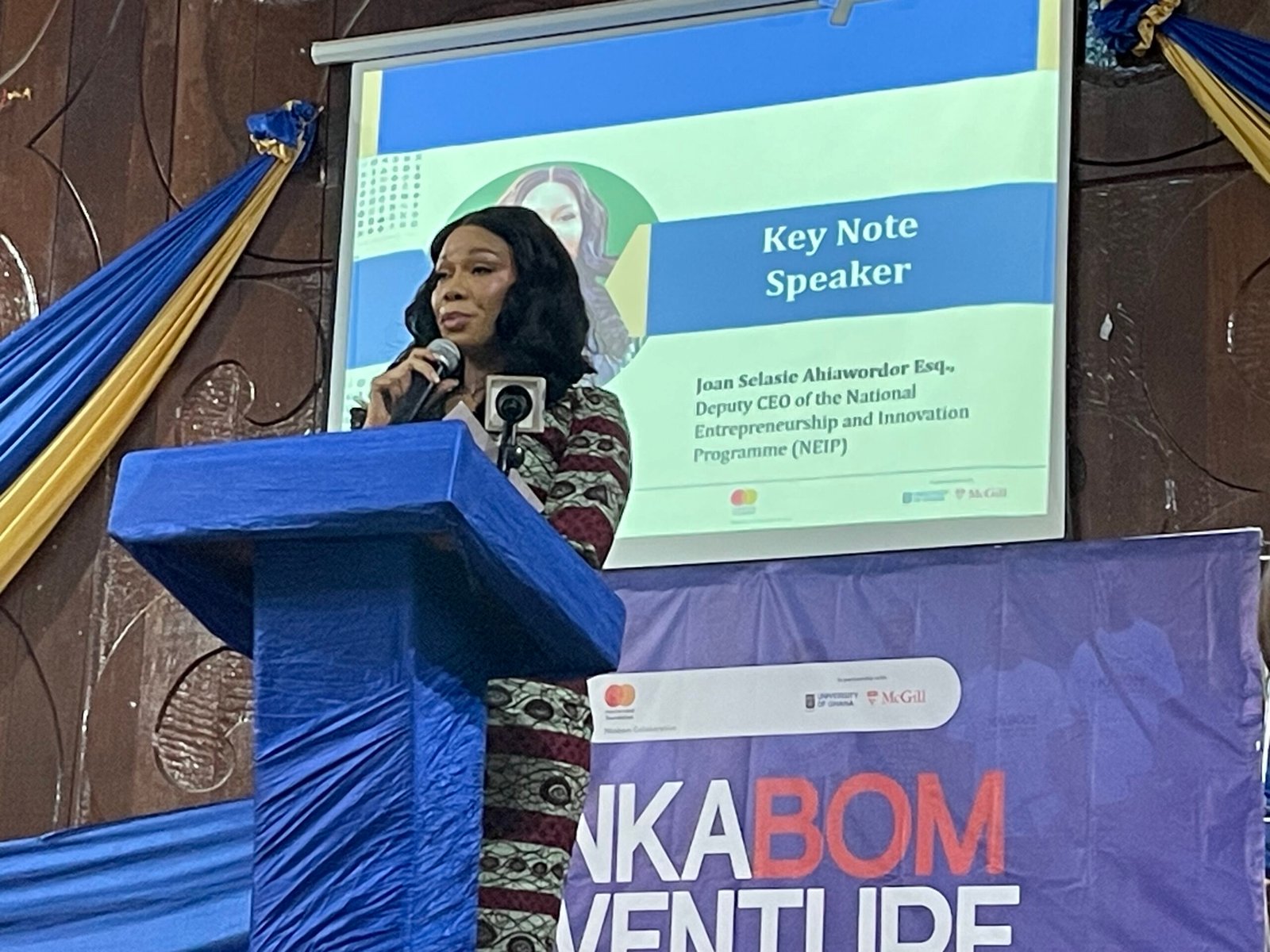
The Deputy Chief Executive Officer of the National Entrepreneurship and Innovation Programme (NEIP), Jean Selasie Ahiawordor, has described the launch of the Nkabom Venture Quest Entrepreneurial Bootcamp Cohort 2 as a strategic investment in Ghana’s future economy.
Speaking at the official launch on Monday, May 11, 2026, at the University of Ghana, Ms. Ahiawordor, who represented NEIP CEO Eric Adjei, said the initiative goes beyond a typical bootcamp and represents a deliberate effort to strengthen youth entrepreneurship in the agrifood sector.
She noted that while Ghana’s entrepreneurial ecosystem is growing, the country still needs sustainable systems that can help startups scale into investment-ready businesses.
“The agrifood sector presents enormous opportunities for economic transformation,” she said, adding that challenges such as low productivity, post-harvest losses, and limited technology adoption can be turned into business opportunities through innovation in agritech, food processing, climate-smart agriculture, and digital marketplaces.
Ms. Ahiawordor highlighted government’s commitment to entrepreneurship through initiatives such as the Adwumawura Programme and the Student Entrepreneurship and Enterprise Development (SEED) Programme, which targets students in tertiary institutions with training, mentorship, and funding opportunities.
She emphasised the importance of collaboration between academia, government, industry, and development partners, stating that startups do not grow in isolation.
On the sidelines of the event, Mr. Pierre Brunache Jr., Director of the Secretariat of the Nkabom Collaborative, disclosed that the 10-year initiative aims to create 55,000 jobs, support 3,000 SMEs, and provide opportunities for about 5,000 women, persons with disabilities, and internally displaced persons in the nutrition and agrifood systems.
The Nkabom Collaborative involves major Ghanaian universities including the University of Ghana, Kwame Nkrumah University of Science and Technology, University of Development Studies, Koforidua Technical University, and Ashesi University, in partnership with the Association of Ghana Industries, McGill University in Canada, and the Mastercard Foundation.
Mr. Brunache Jr. stressed the need for supportive government policies and stronger private sector participation as off-takers to absorb trained youth and address industry pain points.
The Nkabom entrepreneurial residential bootcamp designed to equip participants with practical skills in agri-food entrepreneurship, value chain development, business planning, and climate-smart innovation.
The program combines intensive training, mentorship, and a one-day community roadshow where participants engage directly with farmers, processors, and local stakeholders, to gain real-world insights.
The bootcamp is expected to train and mentor thousands of young people using experiential learning approaches to build viable agribusiness enterprises.